
Waste to Strategic Assets with Geotextile Tubes
Continuous accumulation of fine-grained sediment in stormwater retention basins and reclamation lagoons has become a persistent and costly problem for mining operations worldwide. Complicating matters further, many of these sites are lined with High-Density Polyethylene (HDPE) to prevent contamination of surrounding soil and groundwater. That liner, while essential for containment, becomes a serious obstacle when it comes time to remove accumulated sediment. Conventional mechanical dredging and excavation carry a high risk of puncturing the HDPE layer, and a breach can mean containment failure and expensive repairs.
As described in post #1 “Tailings” (https://terra-sea.com/mining-1-tailings/), of our Mining Series, many tailings’ stockpiles have the potential to serve as secondary resources for recovering precious metals and minerals. The recovery and reprocessing of precious metals from tailings can typically only be done once the solids have been consolidated to a concentration of at least 60%. Reaching that threshold through open-air drying is unreliable at best: rain rewets the material and undoes progress, while wind risks scattering fine particulates and spreading contamination beyond the site boundary.
Geotextile tubes offer a way around both problems. Compared to mechanical systems such as centrifuges or belt presses, they are low-maintenance and energy-efficient, and they let operators dewater and confine tailings without excavating over a vulnerable liner. This makes them especially valuable in environmentally or socially sensitive locations, where the alternative — a conventional tailings dam — carries far greater risk. The process works by pumping slurry into a woven geotextile shell, which captures solids with high efficiency while allowing water to filter out. The result is a high-quality effluent that can either be treated for safe discharge into nearby waterways or recycled directly back into mining operations, reducing overall water demand.
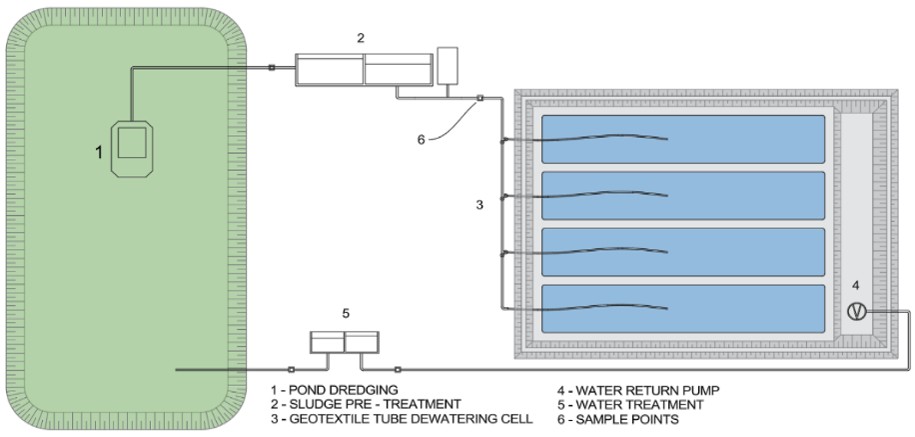
Typical sludge treatment (conceptual) and dewatering operation. Credit: Flint Technical Geosolutions
Perhaps the most compelling case for geotextile tubes is what happens after filling. Rather than functioning as a static waste containment measure, a filled tube becomes a “horizontal silo” — a stored, sequestered, and already-dewatered asset rather than a liability sitting in a sludge pond. Because the heavy lifting of liquid separation is already done, operators retain real flexibility. As extraction technology improves or commodity prices shift, the material inside a tube can be tested for mineral yield and reprocessed economically, something that’s far more difficult with untreated sludge.
Geotextile durability is central to this proposition. Leading manufacturers are producing geotextile tubes rated to maintain structural integrity for 10+ years under direct UV exposure, and essentially indefinitely once covered with soil or synthetic material. That kind of longevity ensures copper, silver, and other metal producers can effectively bank tailings through a market downturn and extract value later, once conditions improve.
As discussed in our Post #3 (https://terra-sea.com/mining-3-how-artisanal-mining-affects-your-coffee/), centralized processing and standardized tailings management hubs can provide a vital infrastructure solution for minimizing and remediating the damage caused by illegal artisanal and small-scale mining (ASM). The properties that make geotextile tubes ideal for long-term tailings storage, also make them particularly well suited to be incorporated into these centralized hubs.
By building “tube farms” — multiple dewatering cells filled and operated in a coordinated sequence — processing and remediation teams can run a high-capacity dewatering operation within a comparatively small footprint. Additives can be introduced inline during filling to improve the capture of heavy metals, and because filled tubes can remain in place over extended periods, solids concentrations keep rising over time while organic contaminants naturally break down.
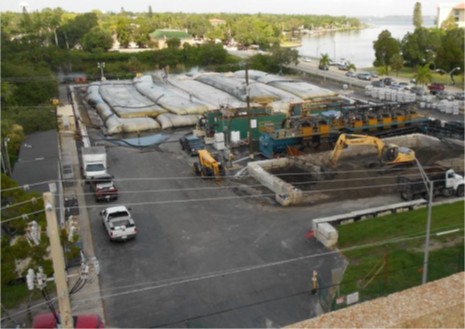 Contaminated river sediment clean-up and dewatering operation.
Credit: Flint Technical Geosolutions
When it comes to environmental remediation of ASM sites, the first step is to dredge large quantities of toxic sludge out. Then stabilize, dewater and contain large volumes of material, before it can be transported or treated safely. This is a logistical challenge at a scale most conventional systems aren’t built for, especially in the remote areas where ASM typically occurs, and where geotextile tubes offer the more financially and operationally feasible option. The system can also be paired with mechanical pre-treatment, such as cyclone separators, to strip out debris and rubbish before the slurry is even processed – streamlining the entire remediation pipeline from contaminated riverbed to safely contained and stored, potentially recoverable material.
This is the fourth post in our series on Mining. Previous posts addressed tailings, intelligent dredging and artisanal mining. Following posts will be on related issues like specializes dredging pipes and landscaping. We invite you to follow us on LinkedIn.
Albert, November 6th, 2026
Terra Sea Technical Solutions Ltd.
© 2026 All Rights Reserved