
Intervening On Nature’s Behalf
A healthy dune system is a living, breathing coastal defence barrier. But when severe storms cause scarping, that barrier can fail catastrophically.
What if we could reinforce the heart of a dune without changing its natural face?
In this post, we explore an emerging approach which allows us to intervene on nature’s behalf—strengthening the coast while still maintaining the natural look and crucial role of the dune system in the coastal ecosystem.
Traditional coastal protection approaches revolved around rigid concrete seawalls. While concrete has a long theoretical lifespan, the hidden cost of hard structures is that they often disrupt local ecosystems and accelerate beach erosion – leading to the loss of the beach itself.
To prevent catastrophic dune breaches related to scarp retreat (discussed in post #3), modern engineering practices are turning to ‘softer’ engineering approaches. An emerging approach utilises geotextile tubes – permeable, chemically and environmentally stable, high-strength industrial-grade sand containers, often hundreds of feet in length – to serve as hidden ‘dune cores’ where they can provide a resilient backbone to the natural dune system. The geotextile tubes are hydraulically filled on-site using a slurry of local sand and seawater pumped directly from the beach or a nearby dredge site – minimising the need for heavy machinery and imported materials, reducing carbon emissions and preventing significant road wear associated with hauling heavy stone or pre-cast concrete, thus minimising damage to the coastal ecosystem.
When used as a dune core, these geotextile tubes should be placed exactly where the scarp would normally form and then buried under layers of natural sand. Correctly placed geotextile tubes can stop the landward retreat of the scarp by providing a physical, non-erodible barrier that holds the foundation of the dune in place, even if the vertical face above it slumps.
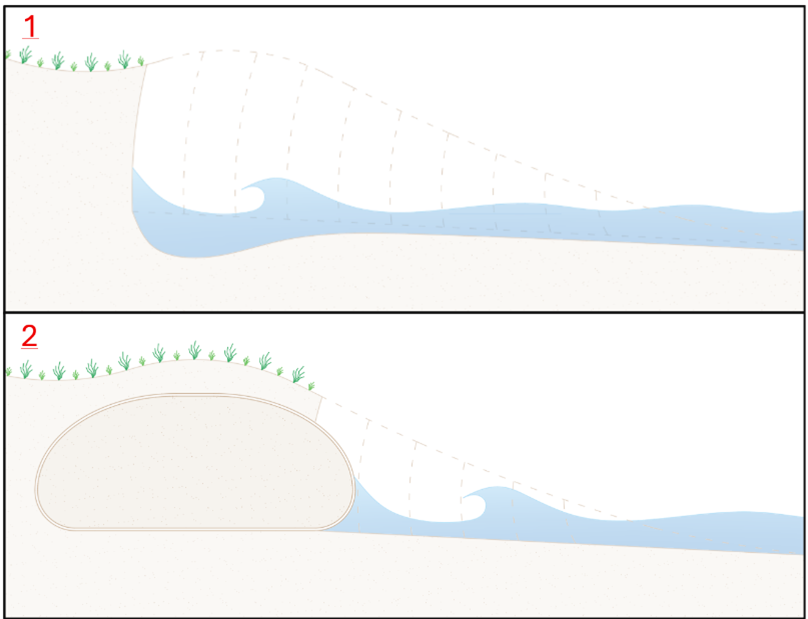
(1) Dune loss to scarp retreat under severe storm conditions (2) Geotextile tube ‘dune core’ preventing further scarp retreat. Note, that adequate scour protection should be implemented to prevent undermining the strcture. Credit: Albert
The dune core configuration works in harmony with natural processes by adapting to varying levels of environmental stress. During minor storms, the outer layer of sand behaves naturally by shifting and absorbing wave energy. In the event of severe storm surges that would normally severely degrade or wash away an entire dune, the core remains where it acts as a barrier, anchoring the foundation of the dune, even if the surface sand is temporarily stripped away. Geotextile tube dune cores essentially provide an invisible, “silent” defence that engages only during severe storms.
Another key strength of this approach is its ability to support natural revegetation – once the geotextile tube is buried, the dune can be replanted with native coastal vegetation whose root systems weave into the sand to further anchor the structure against wind and water erosion. The buried cores also provide a beneficial substrate for local microbes and insects and facilitate the trapping of new windblown sand to help the dune system rebuild itself as the beach recovers from storm events.
This concealed approach softly intervenes on nature’s behalf in a way that supports natural processes, preserves the shoreline’s natural aesthetics and ecological functions. By providing protection when the primary dune is breached, these cores minimize beach narrowing and maintain wide, sandy habitats for both recreation and wildlife. We believe that this balance of environmental sensitivity and robust, “silent” protection makes this approach an ideal strategy for residential areas and nature reserves.
This is the fourth post in our Dune Systems Series. We invite you to follow us on LinkedIn.
Albert
February 12th, 2026
© 2026 All Rights Reserved