
The Science of Scarping: Why Dunes Collapse
In a natural coastal environment, sand dunes serve as dynamic reservoirs that shift in response to wind and water. While these systems are inherently flexible, severe storms can push them to a breaking point, triggering a complex and self-accelerating process of dune failure. By understanding the specific mechanical triggers behind this collapse, we can better appreciate why dunes are so vulnerable to rapid, catastrophic erosion during repeated storm cycles.
During calm weather, waves break far from the shore, allowing sand to remain dry and stable. But during a storm surge, rising water levels allow the ‘swash’—the powerful rush of water up the beach—to strike the dune’s seaward toe directly. This action carves out steep, unstable vertical cliffs known as scarps. Once a scarp is established, the dune enters its most vulnerable phase, as the erosion progresses landward through a destructive ‘loop’ called scarp retreat.
The photo below demonstrates natural scarp formation on a dune system along the coast of South Africa. Red arrows indicate the directin of scarp retreat:
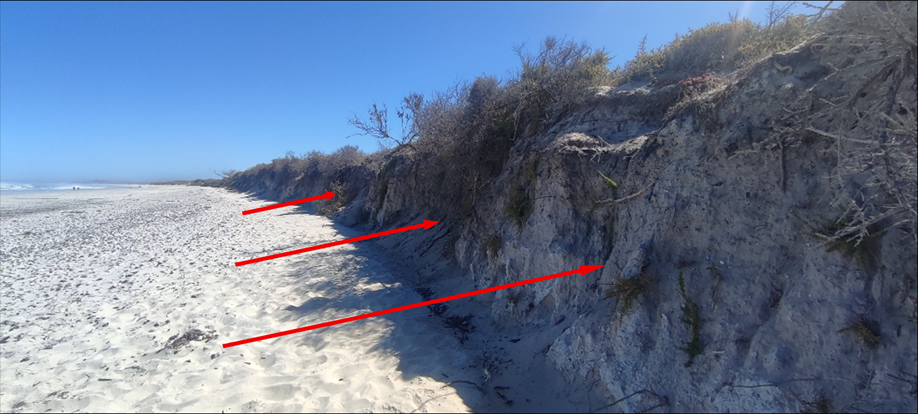
Credit: Albert
As a scarp grows taller and more vertical, the structural integrity of the dune face vanishes. During a storm, the sand becomes saturated; the sheer weight of this water-logged mass triggers ‘toppling,’ where large sections of the dune collapse into the surf at once. This instability persists even after the storm subsides, as the sand at the crest naturally slumps downward, unable to maintain its position against the steep vertical angle.
In addition to the slumping, a vertical scarp fundamentally alters the ocean’s interaction with the land. On a healthy, sloping beach, waves glide upward and lose energy through friction. In contrast, a scarped beach acts like a miniature seawall where, instead of dissipating, wave energy slams into the vertical face and reflects downward (see post #4 of our Coastal Erosion series). This creates a scour effect at the foot of the scarp, deepening the water and allowing even larger, more powerful waves to strike the dune. This cycle creates a dangerous acceleration of the scarping process.
When a dune fails, its sand is often swept far offshore into deep-water sandbars. While this sand may eventually return over years of gentle tides, the recovery of a dune’s full volume can take decades. This ‘recovery gap’ leaves inland ecosystems and human communities exposed and vulnerable to any subsequent storms that occur before the natural defence has time to rebuild.
This is the third post in our Dune Systems Series. Our posts are mailed to our distribution list (click to join) and posted on LinkedIn. We invite you to follow us on LinkedIn.
Albert
January 30th, 2026
© 2026 All Rights Reserved